Previous Losses Analysis
I've analyzed my previous wins in the last blog. Today I will cover two losses; the first one being the revenge $NKE and the second one being $SQM. In this analysis, I'll look for what changed and also how setting a stop loss and discipline helped me lose less money. As a reminder, revenge $NKE trade was when I started this journey, but at the time still didn't know the concepts I know now.
Let's look at $NKE
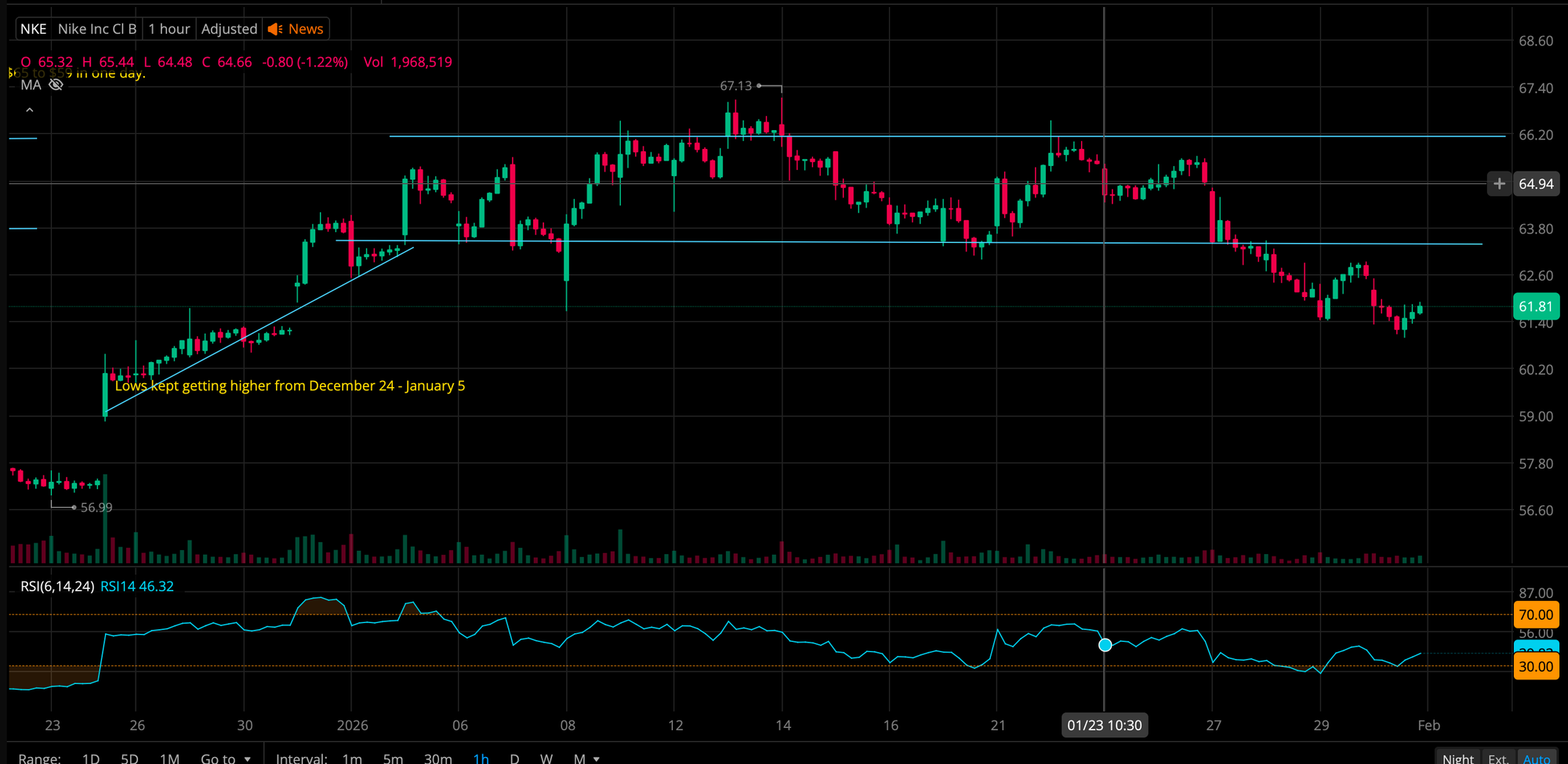
Bought a $NKE call for $66 on January 5, expiring on January 23; the contract cost $1.50. There are many things I'll point out with this $NKE analysis and the biggest lesson on why it wasn't a smart trade.
- There were only ~18 days between January 5 - January 18. I literally purchased this contract during the theta cliff, where theta is more aggressive. I touched on this when i discussed the Greeks.
- Looking at the chart, and looking back, the new channel had not even begun to form. Which means that buying it at a new high price wasn't smart. I now know that ~$66.20 was the resistance, but on January 5, I didn't know what a channel was and if I did, there was no way to rely on this with the abrupt changes we observed with $NKE from the end of December - January.
- On January 5, the closing price was $66, by January 8, $NKE closed at around $61, you can see it in the chart where this crossed the now defined support. This alone costed me $4 in change of price in 3 days, this is in addition to the theta.
- The RSI observed during January 5, and the previous days was above the 70 mark. I also could've used this to understand that there nedeed to be some stabilization. Therefore, the price wasn't going to keep shooting up.
- Although we see a high of $67.13 on January 14, it wasn't enough for me to take profit then as my break-even was $67.50. Although I should've sold at this point to minimize my losses, I didn't, I gambled away due to ignorance.
- The volume on January 14 was overpowered by the sellers, this could've been another clue to exit the contract.
- Looking at the chart now, we can NOW see a somewhat defined channel, but as you can see, this took about 20 days to form.
Key takeaway from this analysis are:
- Don't ever revenge trade
- If a channel is not defined and you haven't studied the channel, then don't take it.
- Minimize your losses by setting a stop loss price and respect it.
Let's move on to $SQM
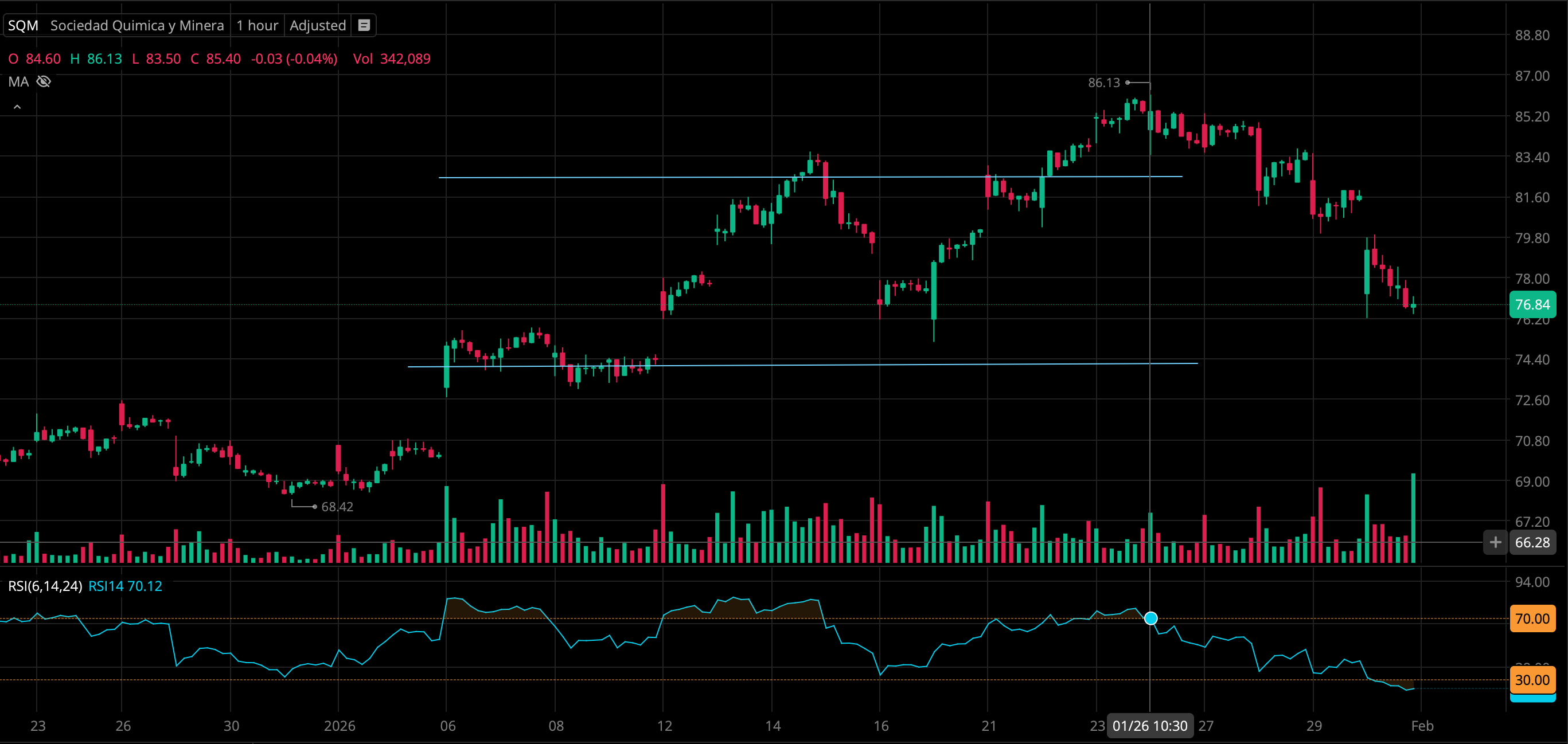
$SQM was fulfilled on January 26, when it reached a high of $86. The call was for $90 expiring on February 20. The contract was bought for $2.40, and I exited this contract on January 29, when we see a close of $81, so my contract closed at $1.45, meaning I took a loss. However, I did minimize my losses by not letting the contract expire and by not letting it go below my stop loss
I'll start by saying that I had hope for $SQM, I wrote about it in the post where I was excited. This is when I had just learned the concept of channels and breakouts, and found it exciting. I thought breaking resistance was good, and it is! But, looking at historical trades, this break-out is not ever lasting, to me there needs to be a recalibration period. Though this may be great for day traders.
Few things:
- $SQM had been quite volatile in my opinion. We see a jump of $74 to $81 from January 8 - January 14, that's 5 days only if we exclude the weekend. We see this happen again between Janaury 16 -January 22, when the price increased by ~$7 in about 5 days. Also indicating votality to me.
- Votality in itself isn't bad, it may not even be bad for options trading, I think it's the opposite, it helps you race theta. However, the channel definition needs to be set retroactively for several days.
- I took this trade because I saw that resistance of $81 had been tested, and on January 21-23, I observed that it closed outside of the "limit" pre-defined by the channel drawn. I falied to consider several factors like RSI, volume, and channel for 14-20 days.
- The RSI on January 23 reached the 70 mark, which again indicated a recalibration was coming. I bought at this time, when a put option would've made more sense.
Thoughts
There are a few mistakes I've taken from this analysis, these mistakes are simply things I didn't keep in mind. I realized I was treating the market like a casino for $NKE and a shortcut for $SQM. The market, unfortunately, has a very expensive tuition fee for those lessons. Trading $SQM then, felt "informed", but looking at the wins analysis and the losses analysis, it makes it clear for me that I was under-informed and not prepared. I didn’t consider all the factors that could’ve made me have a better decision.
All in all, I think it'll be useful to integrate the analysis from both, the wins and losses. I've seen what went good and bad. Although I have learned RSI, I failed to integrate it when buying $SQM, looking back, I need to utilize it better.
- First, I must define channel with prominent support/resistance.
- Understand the RSI for the last 14-20 days.
- Look at volume
- Find a good window so that theta doesn’t shave all my capital
- Possibly integrate diagonals when looking at volatile markets
I've learned a few things from the wins analysis as well as the losses analysis. Things I'll put into context when studying the chart for my next trade.
Member discussion