Sector Rotations
A while back when I first started studying ETFs more deeply I found that there were several sectors to choose from. As mentioned before, it's allowed me to decide to put my money into ETFs rather than single stocks, and I think I prefer it this way for long term investments or even Roth IRAs. Nonetheless, since I moved on to my second ETF options trade (and now exited), there are things that I want to understand like sector rotation. Understanding how rotations occur will eventually allow me to make smarter trade options, especially if I continue to stick to ETFs.
I first noticed sectors rotate after the State of the Union (SOTU) on February 24, 2026. When the president mentioned his take on AI growth, at the same time he mentioned the low gas prices at the pump across the country. From this moment I witnessed XLP rocket and XLE took a hit, even if just briefly. Which then led me to investigate and learn about sector rotation.
So, what is a sector rotation? It‘s the process of moving money from one sector to another. It can also be a strategy, in which investors move their money to keep it at high performing sectors at all times. I personally think it's a great strategy, I am positive that big money is following this... I've wondered 'how do seasoned investors know where to move"?. We have seen this play out in XLI now that I have exited, the current geopolitical issues and high gas prices have greatly affected XLI.
I want to be great at trading and investing. It's one of my goals, therefore I need to grasp this concept. I've wondered "how do seasoned investors know where to move?" I mean certainly, keeping up with the news can be a lot. While it helps, there are other ways as well, which I have now found is comparing a stock/ETF, etc to the SPY. Why the SPY? it is my understanding that SPY is the ocean and the stocks or sectors are the boats, therefore comparison helps.
I will stick with XLI since I just exited and the move to where I think the money is.
Let's compare Industrial sector XLI against SPY:
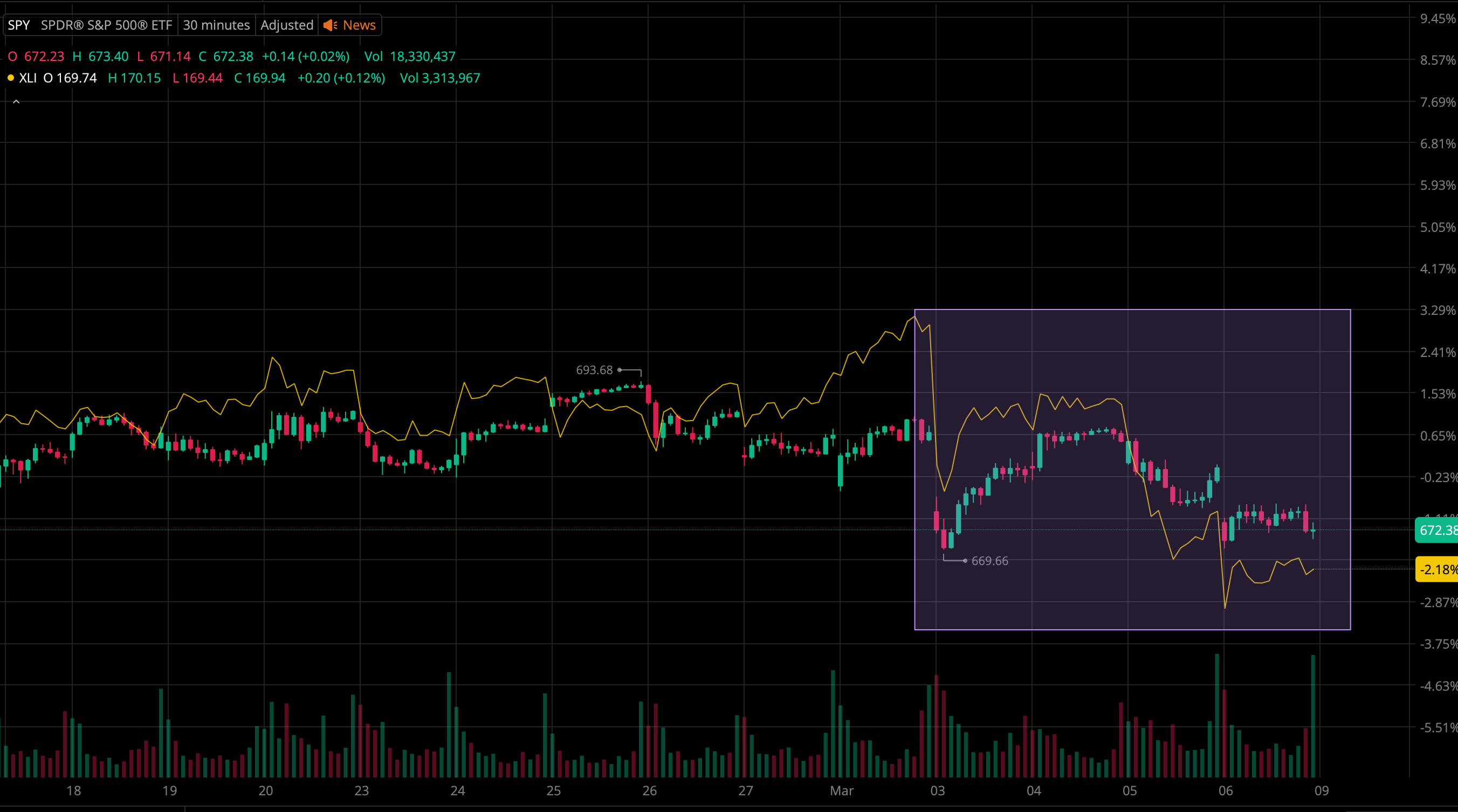
In the above we are looking at SPY and the yellow line represents XLI's change against SPY. We knew XLI was in an uptrend and saw a high of $179 around March 2, 2026 – this is evident in the chart, where the XLI is trending higher than SPY. We see that abrupt drop from March 3 - March 6 (Today) where it flipped and went in a downtrend below SPY. This alone tells us that it might continue to go lower.
Let's look at where I think the money's hiding right now which we know is XLE due to high gas prices, but let's look at XLU (utilities):
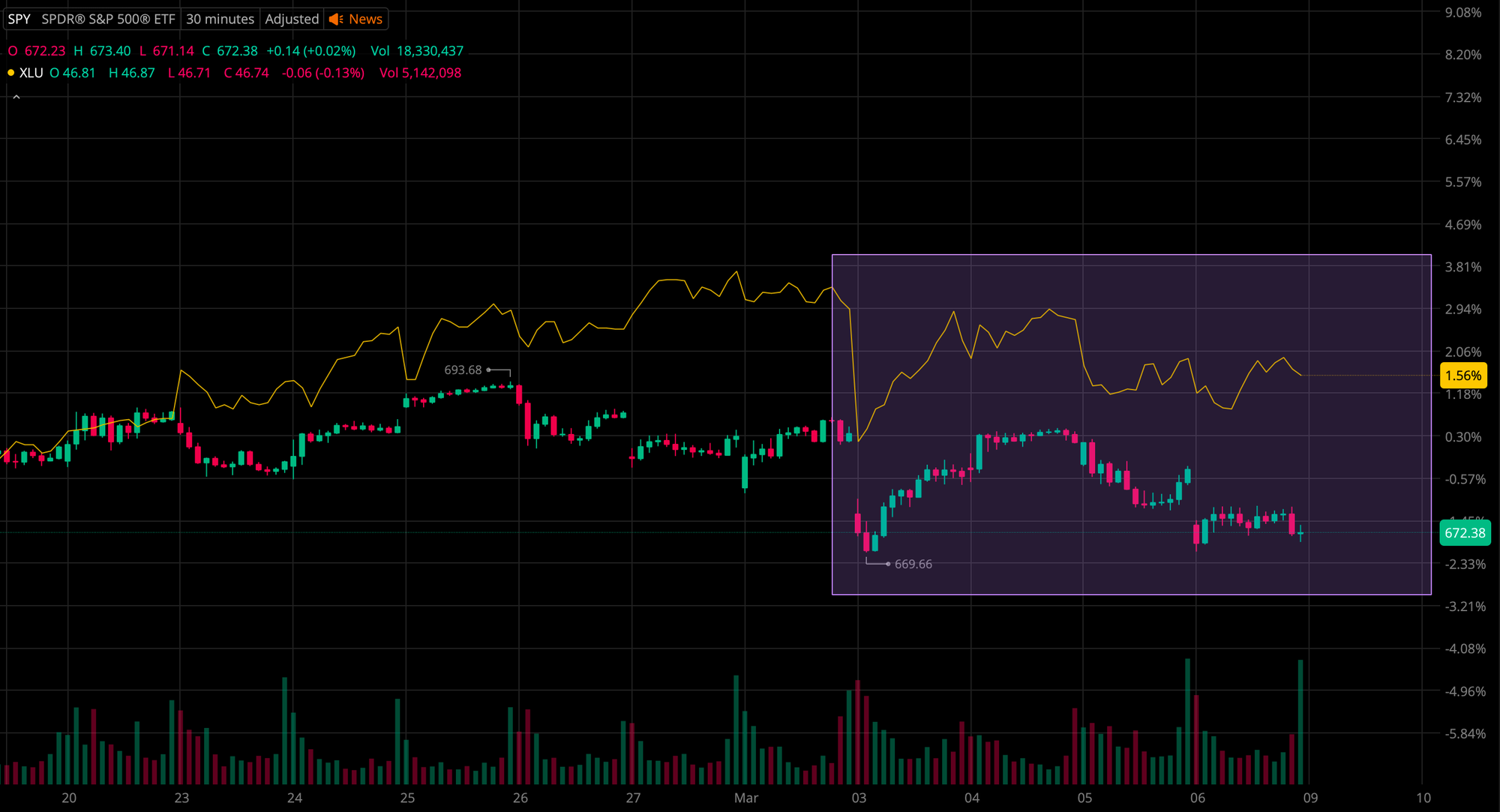
Similarly to XLE, there was certainly a drop at the end of March 2, 2026 in XLU in comparison to SPY, but we see this recovery from March 3 onwards. Today, we can see that XLU continue to trend higher than SPY, which may indicate a good hiding place where the big money players are at.
Overall thoughts
There is so much to learn, everyday there is something new, something I didn't know, something I didn't consider. When I named this blog I didn't entirely know what to expect, but everyday it shows me that the name is rather accurate. I am learning the market by living it.
I want to be a great trader and investor, I want to know how to make sound decisions. People say that the hard part is learning how to be patient and how to do nothing, and managing your emotions. I almost feel like that's not too challenging if you're disciplined enough. While I've had doubts and have experienced FOMO, I have remained stern with myself for the most part, I think it's learning new angles that is getting me, there's so much.
This feels good though, the SPY comparison is something I hadn't considered ever. Nonetheless, if I am focusing on ETFs – whether that is to trade the entire sector or holdings within the sector – I must compare it against the SPY. Big banks know where the money goes, I must as well if I want to be one of the greatest independently.
Member discussion