VIX Indulgence
As mentioned yesterday, VIX (Volatility Index) can tell us about the market in its current state and where it's headed. The changes in VIX can be narrowed to the number of trading days and then divided by 16.
Below is a table of what the range of VIX means in the market.
| VIX Level | Market Environment | Trading Strategy |
| Below 15 | Complacency | "Quiet Waters." Market is trending up smoothly. Options are cheap. |
| 15 – 25 | Normal / Choppy | "Typical Weather." Standard pullbacks occur. Good for range trading. |
| 25 – 35 | High Alert | Current State. Fear is rising. Expect 1%–2% daily swings. Trend is down/fragile. |
| Above 35 | Panic / Crash | "The Storm." Extreme fear. Major sell-offs. High probability of a market bottom soon. |
In the below pane of charts, I will highlight how every data point I'm looking at ties to VIX and its relation to the current market.
- Citigroup has collapsed by ~$10 in a matter of three days. – Top left pane
- The majority of the US sectors are in the red, selloff is triggered. – Left bottom pane
- Top right pane – VIX chart over the last 5 days has shown steady climb up. Based on the table above, we can see that VIX has reached "high alert" triggering downtrends and selling pressures. This is connected to the above point, where the majority of the sectors are in the red. As mentioned yesterday, VIX trends opposite of the market or the main indexes.
- Bottom right pane – Compiled the three main indexes and as shown in the chart and legend of it, it is evident that the market is sinking while VIX pushes to the surface.
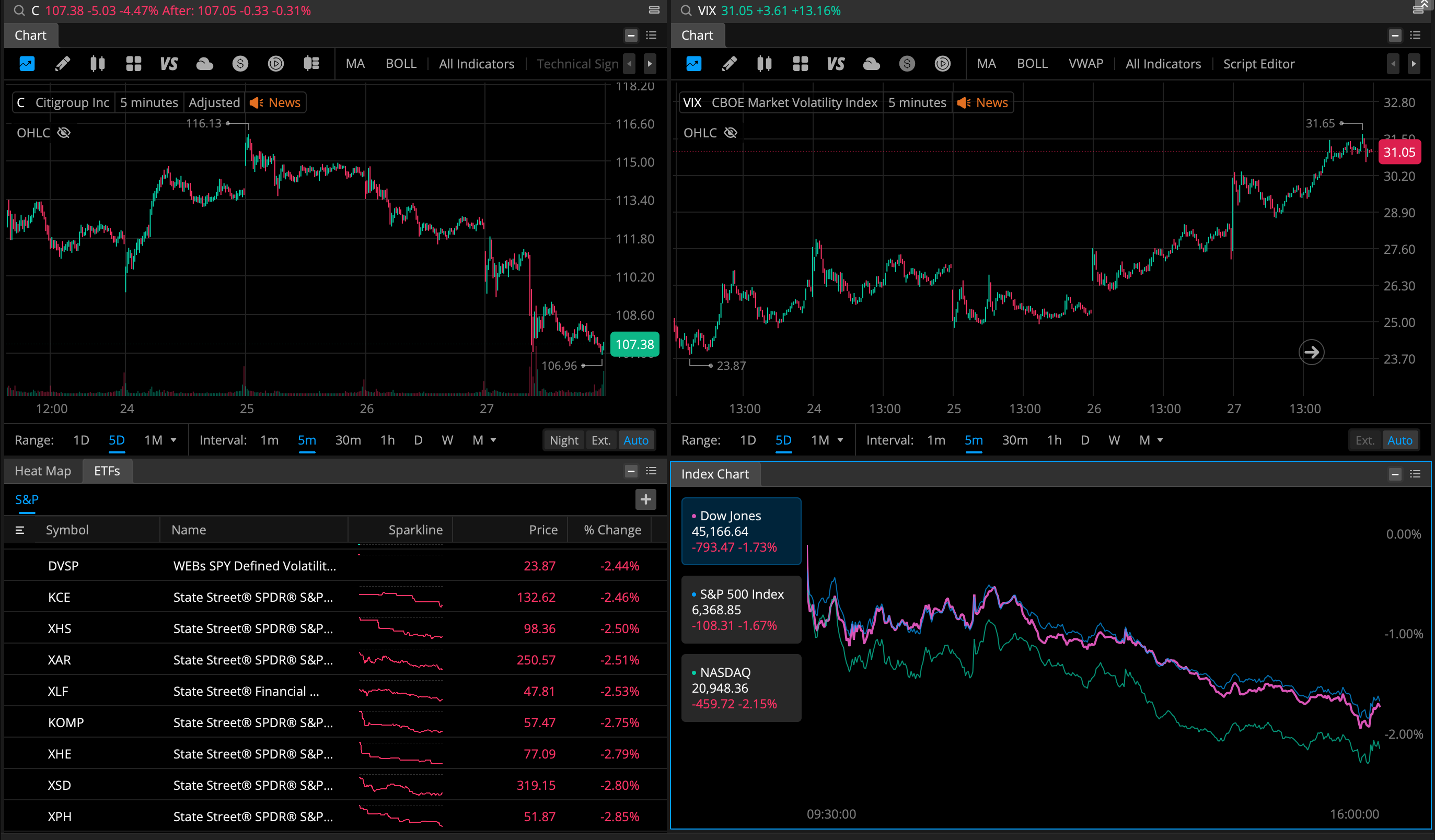
In the above I used Citigroup as an example as it was my original trade before my limit order was triggered early this past week.
Overall VIX is a great index and again, I intend to use it as a tool more than anything else. I can use this to try to read what can happen in the next coming days for a specific stock. While I know that there is still room for inaccuracies when using VIX, I want to give it a shot. This can tell us where the sentiment is on puts vs calls. This gets done by obtaining a ratio, this ratio comes from the open interest. Tomorrow I can use two examples on how this works. At the same time, it will be an opportunity for me to breakdown puts knowledge to make it digestible for me to use in the near future.
Member discussion